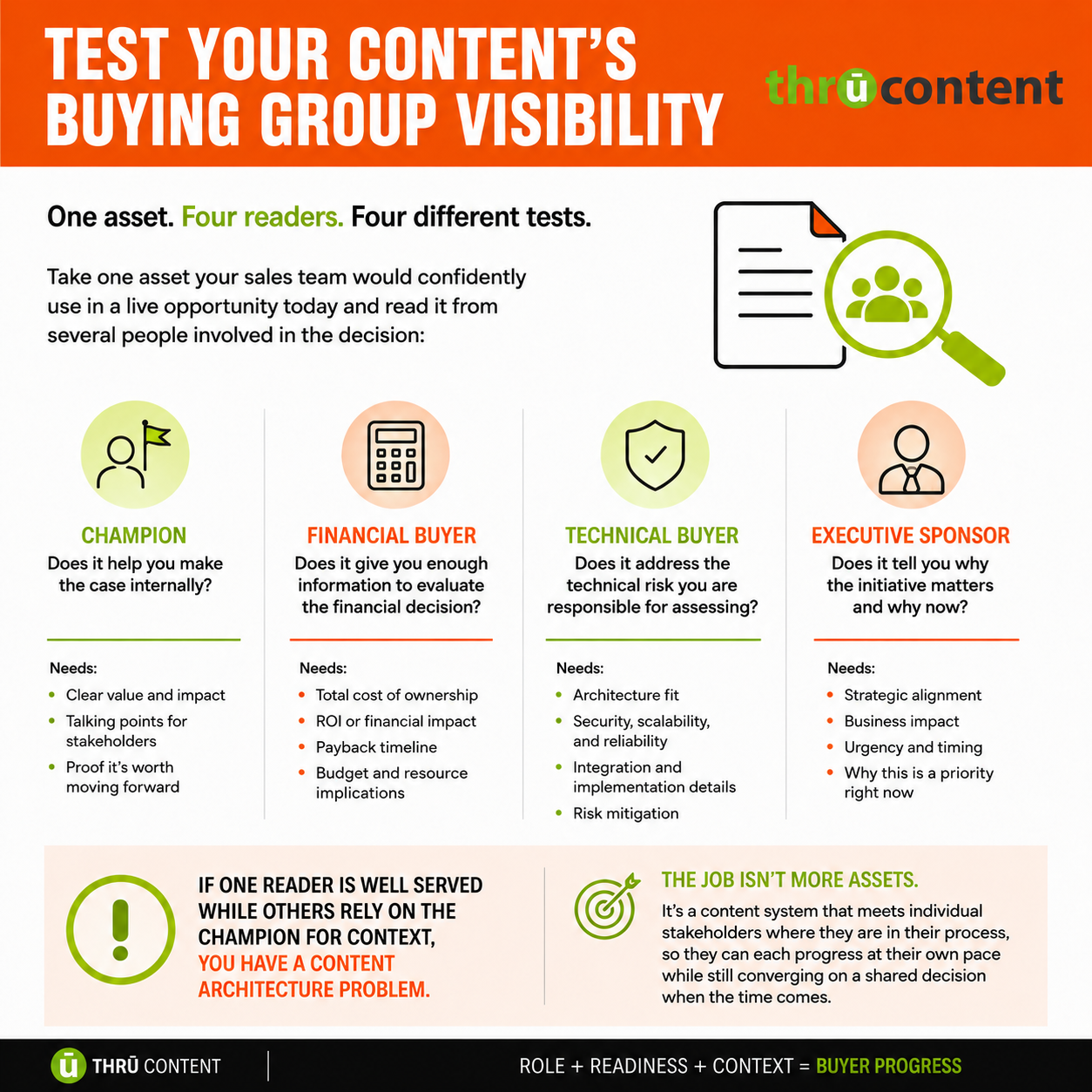
Read a bunch of tech content and you’ll see it’s built around the assumption that one person carries the decision. It often looks something like this:
A champion reads the blog post, finds the product page useful, forwards a data sheet to a colleague, and keeps the deal moving on the strength of their own conviction.
That model fits fewer buying decisions than it used to.
A software purchase that once needed one leader’s approval may now involve security, finance, operations, a technical evaluator, and an executive sponsor who enters the conversation late with an entirely different set of questions. These groups — at the enterprise level — can involve more than 10 people, each bringing a different definition of risk, a different standard of proof, and a different reason to hesitate.
Yet much of the content surrounding the deal is still written for the champion.
The champion becomes the translator
The champion is the natural translator for a buying group. It’s a tough position to be in, serving as the person carrying the opportunity internally. They may need to explain the business case to finance, reassure security, answer technical concerns, and give senior leadership enough confidence to support the decision.
In other words, the champion is left doing the work of translating a message that was never designed for the rest of the buying group. The problem can be hard to see from inside marketing because the content itself may look fine. It’s well-written, sounds good, it’s getting ranked and shared.
The weakness often appears further downstream — especially in deals that stall after a strong first meeting — when sales teams are asking for something credible to send a CFO, or competitor research beginning to circulate inside an account that had looked winnable. Those moments are easy to treat as isolated events.
One “difficult buyer.”
One “slow opportunity.”
One rep who “needs more support.”
One quarter where “timing worked against the team.”
But taken together, they can point to something more structural: a content system that no longer reflects the way decisions are actually made. As buying groups expand — they averaged just over 5 a few years ago — so does the number of beliefs that need to change before a purchase can move forward.
One narrative aimed primarily at the champion cannot reasonably carry all of that weight.
Competitors can fill the gaps
This is where competitive displacement can happen if you’re not careful.
A competitor may publish research a finance leader can use internally, a technical breakdown an evaluator trusts, or evidence that directly addresses a security concern. Those assets keep influencing the decision when the sales team is absent and the champion is no longer controlling the conversation.
If your own content library has nothing built for those readers, someone else gets to shape that part of the decision. And the loss rarely gets attributed to content. It shows up later as price, timing, fit, lack of urgency, or another objection that says very little about what actually happened inside the buying group.
That is why this deserves to be treated as more than a content-production issue.
Volume, cadence, format, and channel mix all matter. But they do not tell you whether the people influencing the purchase have the information they need to move toward a decision. A better diagnostic starts with the opportunities that stalled.
Which member of the buying group had concerns your existing content could not address? If four, five, or ten people regularly influence a typical purchase, how many of them have content built around the questions they are likely to ask? When sales needs something to move an opportunity forward, is the right piece already available, or does someone have to create, adapt, or improvise it in the moment?
The pattern in those answers can tell you far more than another engagement report.
Build around the decision
In many cases, the content itself is not the problem. The team may already be producing strong work. The issue is the gap between a content system built around a primary buyer and a buying process that now depends on several people reaching confidence for different reasons.
Publishing more content without addressing that gap only adds more material around the same part of the decision. A stronger approach starts by mapping who actually influences the purchase, what each person needs to understand or believe, and where those questions emerge as the account moves from initial interest toward a decision.
That gives content a much clearer job: help each member of the buying group reach the confidence they need to move forward.
If your content still centers primarily on the champion, it may be worth mapping the wider buying group against what you already have. The gaps usually become much easier to see once the decision is viewed role by role.
Message us to request a free sample Role + Readiness Matrix to see how a content program around the people, questions, and stages of readiness that shape complex buying decisions would look in your business.