Some stalled deals are easy to explain. The budget disappears, the champion left, or a competitor came in cheaper. Others are harder to diagnose, especially when early conversations went well, the champion stayed engaged, and sales received everything it asked for.
Yet somewhere in the final third of the cycle, the deal began to drift and eventually lost momentum without a clear reason anyone could point to. For a CMO or VP of Marketing responsible for content, pipeline contribution, and explaining performance to the rest of the leadership team, the natural explanation is often capacity. If the team could produce more, turn requests around faster, or cover more topics, perhaps fewer opportunities would get stuck.
That explanation makes sense, particularly in a smaller organization (under 200 employees) where marketing teams are often balancing growth expectations with limited resources. But it assumes the missing ingredient is more content. In many cases, the larger problem is that the content already being produced was built for only part of the buying group.
Buying groups changed faster than most content strategies
Technology purchases once moved forward with the support of one or two senior people. Now, the average buying group is around 10 people, meaning scrutiny comes from finance, security, legal, IT, operations, and other leaders who will either fund the decision, evaluate its risk, or live with its consequences.
Each stakeholder approaches the same purchase with a different set of questions. A functional buyer wants to know whether the product solves the problem in front of them. Finance wants to understand the financial exposure and whether the projected return survives pressure-testing. Security is looking for technical and operational risk. An executive sponsor may be deciding whether the initiative deserves attention alongside several competing priorities.
Most content libraries were not designed around that kind of buying process. They were built around the primary buyer or champion, and they may serve that person extremely well. The problem appears when the content has to travel beyond them.
A champion forwards a case study to the CFO, shares a deck with security, or drops a product brief into an internal conversation with operations. The content may be accurate, useful, and well produced, but if it answers questions those stakeholders are not asking, it does very little to help them move toward agreement.
The champion then becomes responsible for translating the argument for everyone else, which is a risky place for marketing to leave the sale.
Why this is difficult to see in your content metrics
This kind of breakdown is easy to miss because the content may still appear to be performing. All the typical KPIs seem to be doing fine. Engagement is strong, assets are getting shared around, and even sales is using what marketing’s produced. There’s not much to indicate that something has gone wrong.
What those metrics cannot tell you is what happened after the content entered the buying group. You won’t know whether the finance leader see enough evidence to support the investment. Or if security found the answers it needed to become comfortable with the risk. You won’t see if an operational stakeholder understood what implementation would mean for their team or if the executive sponsor see a business reason to keep the initiative moving.
If you can’t see these things, there is rarely a clean marketing signal to draw your attention to it. But it’s the little things that slowly add up and bog your deal down. A stakeholder hesitates, another meeting gets added, additional information is requested, or the opportunity simply stops advancing at the pace everyone expected.
The result gets recorded as a stalled deal, even though the underlying problem may have started with incomplete content coverage much earlier.
Capacity and coverage are different problems
This is where two different marketing challenges often get conflated. A capacity problem asks whether your team has enough people and resources to produce the amount of content the business requires. A coverage problem asks whether that content addresses the people, questions, and concerns that actually shape a buying decision.
Distinguishing between the two is important because adding production capacity does not automatically improve buying group coverage.
A team can be fully booked, consistently hitting its publishing cadence, supporting campaigns, and responding quickly to sales while still having almost nothing designed for the finance evaluator who enters an opportunity late or the security leader who becomes important during a deal’s later stages.
Adding another writer or freelancer may help the team produce more assets. But if the planning model remains centered on the same buyer, the organization simply becomes more efficient at producing content for people it already knows how to reach.
That is why late-stage conversion deserves to be examined as a content architecture problem before it is treated as a production problem.
Use stalled deals to find the gaps
The easiest place to test this is not your content calendar. It is your recent pipeline. Take three opportunities that started strongly and later slowed or disappeared. For each one, identify which stakeholders became important after the initial sales conversations, what each of them was trying to understand, and what content they received.
Then look at the content itself.
Was it actually created for that stakeholder and the decision they were trying to make? Or was it created for the champion and forwarded to everyone else?
A generic customer story may be valuable to the primary buyer because it demonstrates that the product works. But a finance leader may need the same customer experience reframed around financial impact, cost avoidance, or implementation risk. A technical evaluator may need evidence from a peer explaining integration, security, or deployment.
The underlying story can be the same while the information required to make it persuasive changes considerably by role. The same exercise can be applied to the wider content library. Look at what your team produced over the last quarter and ask how much of it was intentionally created for someone other than the primary buyer.
If most of the library still assumes one reader, late-stage opportunities may be exposing a structural weakness the publishing calendar cannot show you.
Put one asset through the buying-group test
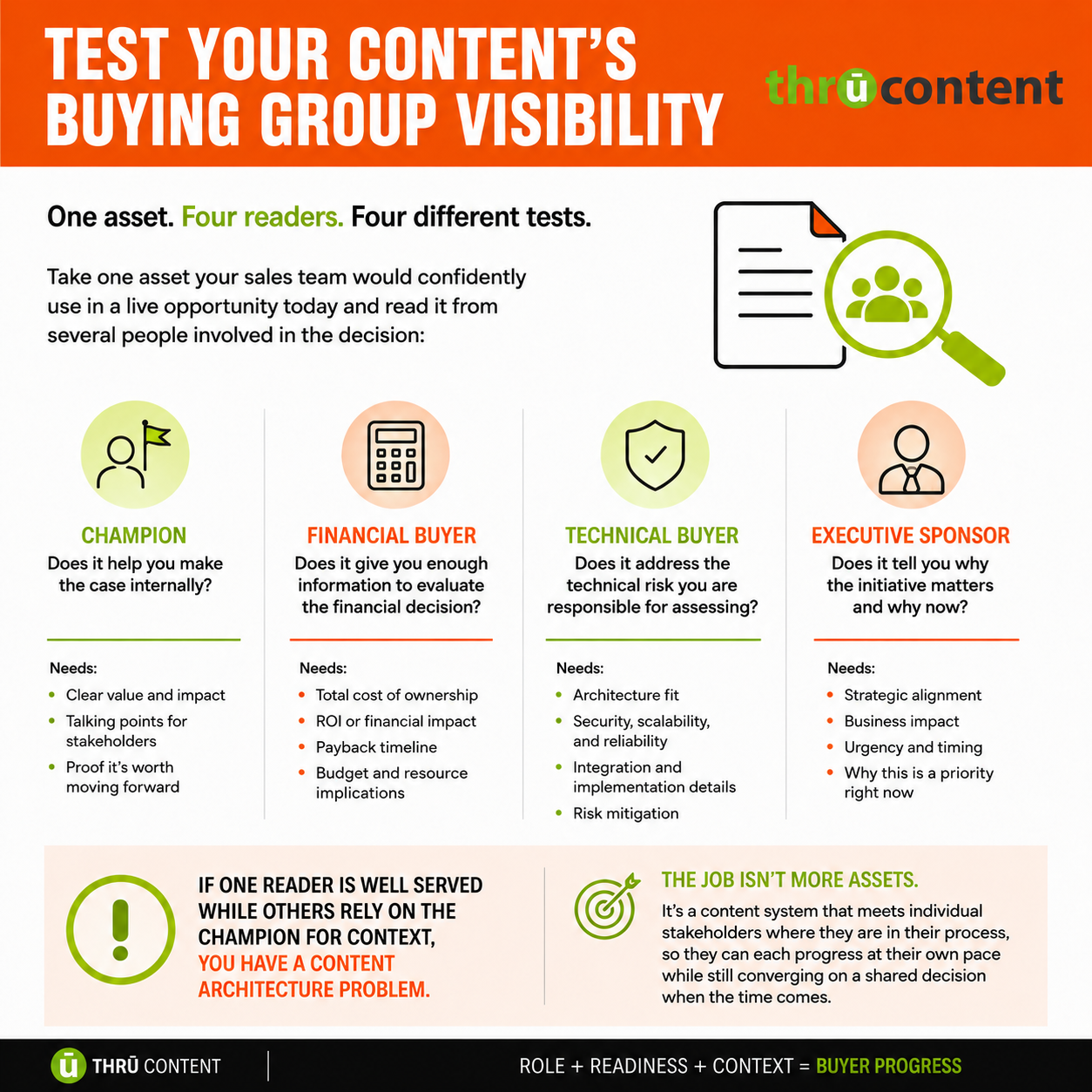
Here’s a simple content audit that can make the problem visible quickly. Take one asset your sales team would confidently use in a live opportunity today and read it from the perspective of several people involved in the decision.
- As the champion, does it help you make the case internally?
- As the CFO, does it give you enough information to evaluate the financial decision?
- As the technical buyer, does it address the technical risk you are responsible for assessing?
- As an executive sponsor entering the opportunity late, does it tell you why the initiative matters and why it deserves action now?
In many content libraries, one of those readers is well served while the others depend on the champion to provide context, interpretation, and reassurance.
That is a lot of influence to outsource to one person inside an account.
Your content model may be the thing that needs reevaluating
None of this means the content is poor or the marketing team is underperforming. In many organizations, the work is good and the production engine is doing exactly what it was built to do. The issue is that the buying environment changed and the company strategy hasn’t.
Average buying groups have added more people over the last few years. Questions have gotten more specialized and specific. Three-quarters of B2B buyer teams now experience unhealthy conflict during the decision process. Yet many content strategies continued to organize around a primary persona, a funnel stage, or a campaign theme rather than the combination of role and readiness that determines what somebody actually needs from marketing at a particular point in the decision.
For marketing leaders reevaluating whether their current content model can support the next stage of growth, that is the more useful question to ask.
Before assuming that stalled pipeline requires another hire, a larger freelance bench, or a higher publishing cadence, pull the last few deals that lost momentum and map the people who mattered. Then look for the person your content never really addressed.